Hijacking the Popular Mandate Through the Indonesia–US ART
The implementation of the new trade pact with Washington exposes a deeper constitutional crisis in Jakarta, as executive overreach threatens to reduce parliament to a mere spectator.

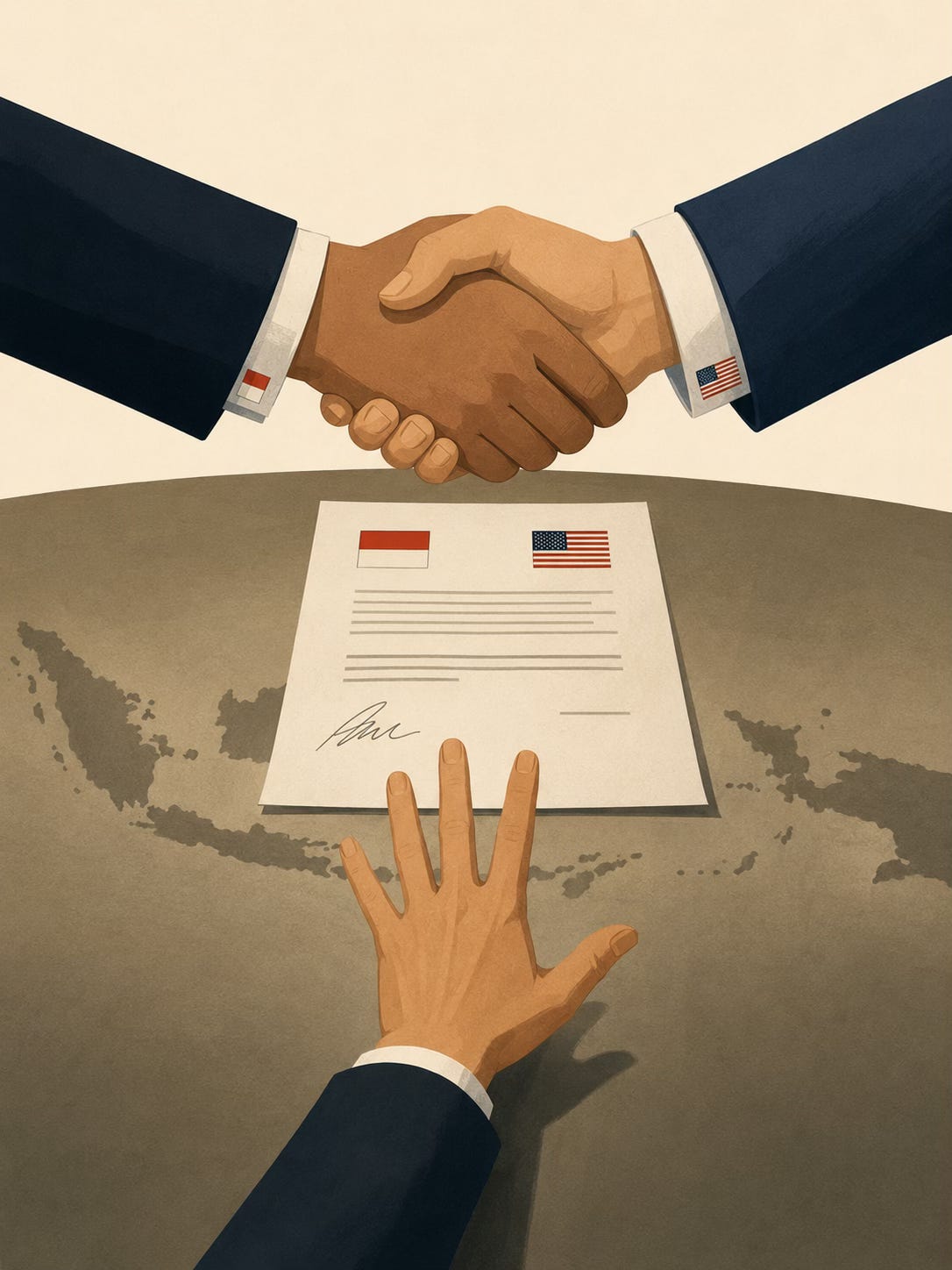
The Agreement on Reciprocal Trade (ART) between Indonesia and the United States is set to take effect on 20 May 2026. On paper, this agreement is a standard reciprocal trade pact. In the realm of statecraft, however, it exposes a far more profound crisis. President Prabowo Subianto has committed the nation to a sweeping international obligation without any visible, explicit approval from the House of Representatives. The core issue here extends well beyond tariffs, market access, or trade balances. The fundamental question is constitutional. From where does the president derive the mandate to bind the state to an agreement of this magnitude?
Article 7.5 of the treaty stipulates that the agreement will enter into force once respective domestic procedures are completed and written notifications are exchanged. The phrase domestic procedures ought to carve out a distinct role for parliament. In a routine technical treaty, such a clause might reasonably be interpreted as a mere administrative formality for the executive. In a strategic pact, that reading is wholly inadequate. This agreement touches upon tariffs, data transfers, digital standards, consumer protection, national industries, food security, minerals, and domestic regulatory space. A scope this vast transforms the pact from a simple commercial deal into an instrument that alters the very trajectory of state power.
The president is undoubtedly the chief architect of diplomacy. A presidential system grants the head of state broad latitude to negotiate, sign documents, and cultivate relations with foreign leaders. Yet the president does not own national sovereignty. Sovereignty remains vested in the people. The constitution positions parliament as a vital check to prevent presidential actions abroad from turning into unilateral burdens for citizens at home. Article 11 of the 1945 Constitution is not merely procedural window dressing. It is a constitutional guardrail designed to prevent foreign policy from devolving into personal diplomacy.
Constitutional Erosion
The problem comes into sharp focus here. As of 18 May 2026, there has been no clear parliamentary process to table the treaty before lawmakers for ratification. Information from within Commission I of the House suggests that no invitation has been extended to debate the pact within a ratification framework. Sectoral discussions regarding data transfers or digital implications are certainly important, and demanding executive clarification is necessary. However, a working committee meeting is not a ratification. Consultation is not a mandate. Listening to an executive presentation is fundamentally different from exercising the constitutional power of assent.
This distinction is critical. The government may argue that parliament has been kept informed, or that discussions are still ongoing. Such responses miss the heart of the matter. In a constitutional democracy, parliament is not an institution designed to receive post-facto explanations. It is the body empowered to grant or withhold a mandate before far-reaching international commitments bind the state. If lawmakers are merely invited to comprehend the fallout rather than determine the approval, their constitutional function is downgraded from granting authority to attending a briefing.
In international relations, a presidential signature is never neutral. Even before a treaty becomes effective, the signature of a head of state creates a diplomatic reality. The partner state assumes a political commitment exists. Cancellation becomes costly, and delays are read as a sign of diplomatic friction. Consequently, parliament does not step into a vacuum, but rather into a space fraught with reputational pressure, partner expectations, and political costs. The most effective way to sideline a parliament is not always to silence it. It is enough to make the decision first and let the legislature catch up later.
In his seminal 1988 essay, Diplomacy and Domestic Politics: The Logic of Two-Level Games, published in International Organisation, Robert D. Putnam demonstrated that international negotiations always take place at two tables simultaneously. At the international table, the leader negotiates with foreign states while constrained by the domestic mandate from the internal table. Domestic constraints are not a weakness. In fact, they can be a potent source of bargaining leverage. A negotiator can credibly inform a foreign counterpart that certain concessions are impossible because they would never clear parliament. For a government that respects its constitution, parliament is not an obstacle to diplomacy. It is a shield in negotiations.
This treaty demonstrates the exact opposite. Domestic mechanisms appear to be treated as a secondary afterthought. The president signs, the government explains, and parliament scrambles to catch up. This pattern weakens Indonesia on two fronts. Externally, foreign partners learn that strategic decisions can be settled almost exclusively through the executive. Internally, the public learns that sweeping agreements can be presented as a fait accompli. The state appears nimble at the diplomatic table, but fragile in its democratic mandate.
This phenomenon did not emerge in a vacuum. In recent years, the constitutional power of parliament has steadily eroded amid executive overreach. Since the pandemic, the legislature’s budgetary authority has been chipped away through a pattern of managing the state budget without the standard scrutiny of formal mid-year revisions. The emergency justifications at the time were understandable, given the state’s fiscal needs. Yet emergencies frequently leave behind habits of power. The executive becomes accustomed to moving swiftly, and parliament becomes accustomed to playing catch-up. That same logic has now migrated from state budgets to foreign affairs.
Executive Overreach
The parallel is straightforward. In budgetary matters, the executive encroached upon the legislative domain to control public funds. In this treaty, the executive encroaches upon that same domain to bind the state. The former concerns the distribution of resources, while the latter concerns the position of the nation within the international system. Both sit at the very heart of parliamentary governance. If both functions are reduced to mere retrospective formalities, the constitution does not need to be formally amended to be weakened. It is enough to make delayed procedures the new norm.
President Prabowo cannot hide behind the pretext that this is merely a trade agreement. The moment a treaty regulates data, minerals, food, digital standards, and national regulatory space, it enters the strategic realm of the state. Nor is it enough for the president to claim that domestic procedures will be, or are being, fulfilled. The primary question remains unchanged. Has parliament been asked for its formal assent as a constitutional body, or has it merely been briefed as a junior partner to the executive?
This issue is not born of anti-American sentiment or an aversion to trade. A state is entirely entitled to forge agreements with any global power, provided national interests are calculated with absolute clarity. The real issue is the limit of presidential power. Foreign policy is not the private domain of the palace. International treaties are not mere letters of intent between leaders. Documents like this treaty bind the state well beyond the term of the sitting president and restrict the policy space of future administrations. A mandate for a commitment of this scale must never be smuggled through the technical vernacular of diplomacy.
Parliament must also stop playing the passive victim. The hijacking of legislative functions cannot occur without a parliament that allows itself to be sidelined. If lawmakers only demand explanations after the presidential signature has dried, the problem is not merely an overreaching executive. It is also a legislature that is too slow to guard its own authority. In a political system characterised by a weak opposition and an oversized coalition, Article 11 of the 1945 Constitution can easily devolve from a constitutional guardrail into an ornamental procedure.
The danger of this treaty lies not only in its specific clauses with the United States. The greatest peril is the precedent it sets. Today, the issue is trade, data, minerals, and digital standards. Tomorrow it could involve defence, military technology, logistics bases, strategic supply chains, or security pacts. If the president can sign a commitment as vast as this treaty and leave parliament to catch up through retrospective briefings, then foreign policy has moved beyond the boundaries of the constitution.
Democracy does not stop at the water’s edge. It is precisely when a government confronts a foreign power that domestic constitutional controls must work hardest. Without them, diplomacy transforms into an unmonitored realm of absolute executive prerogative. The current controversy shows that the core issue in Indonesian foreign policy today is not merely where the country is heading, but who has the right to decide that direction. In a constitutional democracy, the president has the right to lead diplomacy, but never to replace the mandate of the people.
Virdika Rizky Utama, Executive Director of the PARA Syndicate and Doctoral Scholar in Chinese Politics at Nanyang Technological University (NTU), Singapore
*This article was originally published in Tempo on Wednesday, 20 May 2026.